Companion Health
The Signal Layer · Institutional artefact v1.0
Presenter mode · arrow keys advance
01 · Opening

The Signal Layer.

Biological intelligence infrastructure for the pet ecosystem.

The future of pet care is continuous intelligence.

Modern pet ecosystems remain operationally blind to longitudinal behavioural signals. This is the layer beneath that becomes inevitable.

02 · The Blind Spot

Pet ecosystems today are reactive.

Modern pet ecosystems capture events well. Appointments. Records. Transactions. Reminders. Each system is competent at the function it was built for.

What no system captures is the space between events — the months of behavioural drift, the slow decline in hydration, the reduced persistence of activity, the changes in circadian rhythm that precede every visible clinical episode. By the time a symptom presents, the behavioural pattern has been emerging for months.

This is the blind spot. Not absence of data. Absence of synthesis.

Fig 02.01 · Visible symptom vs. behavioural drift · temporal asymmetry
Behavioural drift precedes visible symptom by months T-90 days T-60 T-30 T-14 T-0 BEHAVIOURAL DRIFT — INVISIBLE TO CURRENT SYSTEMS EVENT CAPTURE — WHAT EXISTING SYSTEMS SEE VISIBLE ~ 60 days of drift precedes the event
03 · The Market Shift

Telemetry without synthesis is noise at scale.

Wearables. Smart feeders. Veterinary EMRs. Insurance claims systems. Shelter management platforms. Consumer apps. Pet super apps. Marketplace operators. Each generates a continuous stream of behavioural and physiological observation.

Together, they generate more telemetry per Subject per day than any previous era of veterinary medicine. Apart, none of them produce intelligence. The signals exist. The synthesis layer does not.

The shift now underway is from fragmented event capture to continuous longitudinal intelligence — the same shift human healthcare underwent across the last decade. The question is no longer whether the shift happens. The question is which infrastructure layer becomes the substrate.

Fig 03.01 · Signal journey · telemetry → signal → fetch → interpretation → outcome
Distributed telemetry origins — synthesis layer absent FIG 03.01 DISTRIBUTED TELEMETRY ORIGINS SYNTHESIS LAYER ABSENT Wearables Smart feeders Veterinary EMR Claims systems Shelter platforms Consumer apps Pet super apps Marketplace operators SYNTHESIS LAYER ABSENT ONE SUBJECT, MANY RELATIONSHIPS, ONE API FetchAPI
PART ONE · 04 — THE OBJECT

What is a Signal?

Seven primitive objects compose the complete ontology. Every output, every Brief, every consumer-facing derivative resolves back to these seven.
PRIMITIVES7
SUBJECTpet_04A
COHORTn=1,247
CONFIDENCE0.78
04 · What is a Signal?

Events are not intelligence.

A Signal is not a measurement. It is a behaviourally meaningful deviation from a Subject's baseline, sustained beyond noise tolerance, qualified by persistence, weighted by confidence, and reviewable through replay.

The Signal Layer is composed of seven primitive objects. Together they form the complete ontology. Every output, every Brief, every consumer-facing derivative resolves back to these seven.

Canonical primitives · seven in order
01
Root
Subject
The individual organism whose telemetry originates the Signal Layer's intelligence. The atomic identity of the system. Every other primitive resolves through Subject.
→ GET /subjects/{id}
Registered Baselining Observed Archived
BehaviourRegistered, observed, baselined, replayed. Never deleted — record persists.
ContextsPet · Dog · Cat · Animal · Patient · Insured Animal · Shelter Resident · Research Animal
02
Emergence
Signal
A behaviourally meaningful deviation from a Subject's baseline, sustained beyond noise tolerance. Events are not Signals. Signals emerge from longitudinal synthesis.
→ GET /subjects/{id}/signals
Latent Emerging Active Resolved
BehaviourCan emerge, strengthen, weaken, resolve. Continuum, not binary.
Property ofA Subject. Never freestanding.
03
Continuity
Persistence
The temporal continuity that elevates deviation into Signal. A two-hour deviation is noise. A two-week deviation is a Signal. Persistence is the qualifier.
→ /signals/{id}?include=persistence
Insufficient Qualifying Sustained Historical
BehaviourAccumulates. Cannot decrease. Locks historically once Signal resolves.
EncodesDuration of deviation, not magnitude.
04
Rate
Velocity
The rate and directionality of change in a persisting Signal. Velocity determines intervention urgency. A slow Signal allows extended observation. An accelerating Signal compresses the window.
→ /signals/{id}?include=velocity
Stable Accelerating Decelerating Reversing
BehaviourContinuously recomputed. Fluctuates without changing Signal state.
EncodesFirst derivative of deviation magnitude over time.
05
Certainty
Confidence
Modelled certainty in a Signal's clinical or behavioural meaning, expressed continuously between 0.00 and 1.00. The system never asserts. It discloses certainty alongside every Signal.
→ /signals/{id}?include=confidence
Provisional Strengthening Established Reaffirmed
BehaviourAlways disclosed. Interpretation is consumer-specific. Infrastructure does not diagnose.
DisplayNumeric (C=0.72) and visual (opacity).
06
History
Replay
The temporal reconstruction of how a Signal emerged, persisted, and evolved. A forensic timeline of a Subject's behavioural history. Reviewable, immutable, scrubbable.
→ GET /subjects/{id}/replay?from=T-14
Recording Available Under Review Archived
BehaviourImmutable. Never alters the historical record. Reconstructs it.
Distinguishes fromMonitoring. Monitoring shows the present. Replay shows emergence.
07
Substrate
Cohort
A statistically grouped population of Subjects providing the comparative substrate for Signal interpretation. No Signal is interpretable in isolation. Every Signal is interpreted against a Cohort.
→ GET /cohorts/{id}
Forming Stable Refining Mature
BehaviourDynamic. Refines as Subjects accumulate. Compounds with scale.
DefinesSpecies · age band · context · baseline class · breed-specific grouping

Derived intelligence objects

Composed from primitives · never primitive themselves

Derived objects are produced by the interaction of primitives. Risk is derived, never primitive. This distinction is constitutional. Intervention Window is the first-class derived object — the bridge between intelligence and action.

Risk Score
Derived synthesis. One of several derived outputs. Insurance Brief artefact.
Risk Band
Categorical projection of Risk Score across a defined population.
Lead Time
Days between Signal disclosure and corresponding clinical event.
Clinical Brief
Interpretation Layer output for veterinary consumers.
Underwriting Brief
Interpretation Layer output for insurance carriers.
Fig 04.01 · Canonical anatomy of intelligence · feline subject, baseline through Signal emergence
Canonical anatomy of intelligence SUBJECT COHORT BASELINE DEVIATION VELOCITY PERSISTENCE CONFIDENCE INTERVENTION REPLAY subject_id: pet_04A · feline · age 11 · breed: domestic shorthair cohort: feline · age 10–12 · n=1,247 baseline −18% activity accelerating sustained · 14d C = 0.78 · established SIGNAL · emerges T-14 window: 19 days · action effective T-28 T-21 T-14 T-7 T-0

A feline Subject's behavioural drift across 28 days. Activity persistence declines from baseline at T-14. The deviation qualifies as Signal after 14 days of accumulated persistence. Velocity registers acceleration through the second week. Confidence rises from provisional to established. The Intervention Window opens at Signal emergence and remains active for 19 days. Replay is reviewable at any consumer-specific timestamp. This is the canonical anatomy used throughout every Companion Health artefact.

05 · Companion Health

The layer where telemetry becomes intelligence.

Companion Health is biological intelligence infrastructure for the global pet ecosystem.

Constitutional identity statement · reproduced verbatim across every Companion Health artefact

Companion Health is not an app. It is not a dashboard. It is not a wellness tracker, a veterinary EMR, an insurance product, or a wearable. It is the synthesis layer between fragmented telemetry inputs and the unified intelligence required to make pet care continuous rather than reactive.

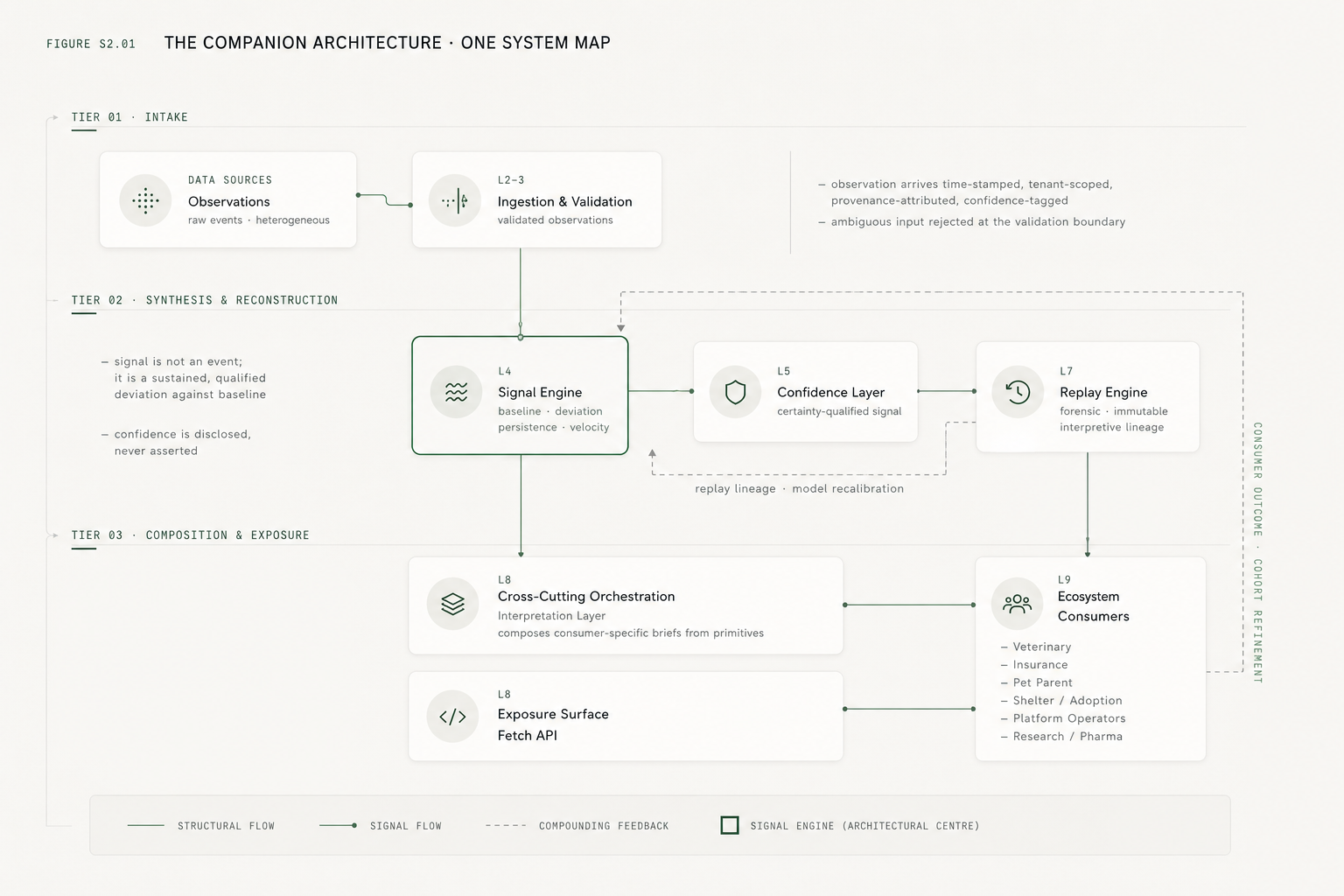
The Signal Layer performs five operations: ingestion of distributed telemetry; validation and normalisation; synthesis into Signals; confidence modelling; and reviewable replay. These five operations compose a stack of nine layers, with the Signal Engine at its structural centre. surface · /signals · /subjects · /replay · /cohorts

From the Signal Layer, intelligence flows through Fetch API into the Interpretation Layer — a cross-cutting orchestration tier — which translates raw primitives into consumer-specific Briefs. The same Signal becomes a Clinical Brief for veterinary, an Underwriting Brief for insurance, a Caregiver Brief for the household, and an Adoption Brief for shelters.

Fig 05.01 · Tier 1 Infrastructure · noise → subject → synthesis → longitudinal intelligence → outcomes
Tier 1 Infrastructure — five-stage synthesis flow 01 · NOISE 02 · SUBJECT 03 · SYNTHESIS 04 · LONGITUDINAL INTELLIGENCE 05 · OUTCOMES DISTRIBUTED TELEMETRY PET_04A A SINGLE SUBJECT Ingest Normalise Synthesise SIGNAL LAYER TIME-INDEXED TRUTH Clinical Underwriting Caregiver BRIEFS — SYNTHESIS CONVERTS LIVED TIME INTO ADDRESSABLE INTELLIGENCE —
06 · Fetch API

The API is the public expression of the ontology.

Fetch API is not documentation. It is the surface through which the Signal Layer becomes addressable infrastructure. Every primitive resolves to an endpoint. Every Brief resolves to an endpoint. The API is the category language made executable.

Fetch exposes two endpoint families. The primitive family addresses the seven canonical objects of the Signal Layer directly. The Brief family addresses outputs of the Interpretation Layer — consumer-specific translations of those primitives. Sophisticated consumers consume primitives. Embedded experiences consume Briefs. Both are first-class.

Fetch API · endpoint topology

Primitive endpoints

GET /subjects/{id} GET /subjects/{id}/signals GET /signals/{id} GET /signals/{id}/replay GET /subjects/{id}/replay GET /subjects/{id}/intervention-window GET /cohorts/{id} GET /cohorts/{id}/members

Brief endpoints · Interpretation Layer

GET /briefs/clinical/{subject_id} GET /briefs/underwriting/{subject_id} GET /briefs/caregiver/{subject_id} GET /briefs/adoption/{subject_id} GET /signals/research/{cohort_id} GET /feeds/platform/{partner_id} POST /events/ingest POST /webhooks/subscribe
Canonical response · Signal object · feline subject
// GET /subjects/pet_04A/signals?active=true
{
  "subject_id": "pet_04A",
  "species": "feline",
  "signals": [
    {
      "signal_id": "sig_2026_03_a91",
      "type": "activity_persistence_decline",
      "state": "active",
      "emerged_at": "2026-04-22T08:14:00Z",
      "persistence": { "state": "sustained", "duration_days": 14 },
      "velocity": { "state": "accelerating", "rate": 0.42 },
      "confidence": { "value": 0.78, "state": "established" },
      "cohort_id": "cohort_feline_age_10_12_n1247",
      "replay_url": "/subjects/pet_04A/replay?from=T-28",
      "intervention_window": { "opens": "2026-04-22", "closes": "2026-05-11", "days_remaining": 19 }
    }
  ]
}
07 · The Signal Engine

Synthesis is not detection. It is reconstruction.

The Signal Engine does not match patterns. It reconstructs trajectories. Each Subject's baseline is continuously refined; deviation is calculated against cohort-adjusted norms; persistence is qualified before any Signal is recognised; velocity is computed across the persisting window; confidence is modelled, not asserted; and the full sequence becomes immutable Replay.

The Engine operates in six discrete operations. Each is independently observable. Each produces a derived state addressable through Fetch. The sequence below traces a real feline subject through fourteen days of activity persistence decline — the same Subject visualised in Section 4's canonical anatomy.

01
Baseline establishment
Continuous refinement of the Subject's behavioural reference state across rolling temporal windows. Activity, hydration, posture, circadian patterns — each maintained per-Subject and per-cohort.→ /subjects/{id}/baseline
02
Deviation calculation
Per-axis deviation against cohort-adjusted baseline. A 12% activity reduction in a feline subject aged 10–12 means something different than the same reduction in a 2-year-old. The cohort context is what makes the deviation interpretable.→ /subjects/{id}/deviations
03
Persistence qualification
Noise filtering through temporal accumulation. A two-hour deviation is discarded. A two-day deviation enters a qualifying state. A fourteen-day deviation is qualified as Signal-ready. This is the threshold that distinguishes Signal from anomaly.→ /signals/{id}?include=persistence
04
Velocity computation
First derivative of deviation magnitude over the persisting window. Velocity registers acceleration, deceleration, or reversal. Acceleration compresses the Intervention Window. Deceleration extends it.→ /signals/{id}?include=velocity
05
Confidence modelling
Modelled certainty against historical calibration. Confidence is not output as a binary classification. It is a continuous value disclosed alongside every Signal. Consumers receive both the Signal and the system's certainty in it.→ /signals/{id}?include=confidence
06
Replay reconstruction
Immutable temporal reconstruction of the Signal's emergence. Reviewable at any historical timestamp. The Replay does not interpret. It reconstructs. Interpretation is performed downstream by the Interpretation Layer.→ /subjects/{id}/replay
Forensic replay · feline subject · activity persistence decline
subject_id: pet_04A · T-28 to T-0 · replay_id: rpl_2026_05_a91
Forensic replay of Signal emergence over 28 days ACTIVITY PERSISTENCE HYDRATION DEVIATION CONFIDENCE SIGNAL · T-14 T-28 T-24 T-20 T-14 T-10 T-7 T-3 T-0 deviation begins T-21 · persistence qualifies T-14 · signal emerges · confidence rises · intervention window: 19 days remaining
PART ONE · 08 — THE STACK

Not a model. A stack.

Nine numbered layers compose the vertical structure. One cross-cutting interpretation tier operates laterally. The Signal Engine sits at the structural centre.
LAYERS9
ENGINEL4
INGEST12.3 MB/s
MODELckd-v1.0 · 0.847
08 · Architecture

The Signal Layer is not a model. It is a stack.

Nine numbered layers compose the Signal Layer's vertical structure. A logical Interpretation Layer operates laterally between Fetch API and the consumer surface. The Signal Engine sits at the structural centre.

Each layer has a single, defined responsibility. Layers do not overlap. Telemetry flows upward through ingestion, validation, synthesis, confidence modelling, risk synthesis, replay, and distribution. Consumer-specific interpretation occurs orthogonally — not as a stack layer, but as a cross-cutting orchestration tier between distribution and consumption.

Fig 08.01 · The nine-layer architecture
L 9
Ecosystem Consumers
Where intelligence is interpreted into operational action. Veterinary, insurance, household, shelter, ecosystem platforms, research.
consumption surface · interpretation-specific
L 8
Fetch API
Public surface of the ontology. Two endpoint families: primitive (direct) and Brief (interpreted).
REST · webhooks · streaming · OAuth 2.1
L 7
Replay Engine
Immutable temporal reconstruction. Every Signal becomes reviewable at any historical timestamp.
columnar time-series · append-only log
L 6
Risk Synthesis
Derived intelligence — Risk Score, Risk Band, Lead Time, Intervention Window. Outputs flow upward to Fetch.
cohort-weighted convergence
L 5
Confidence Layer
Continuous certainty modelling against historical calibration. Never assert. Always disclose.
calibrated probability surface
L 4 ◆
Signal Engine
Synthesis core. Baseline, deviation, persistence, velocity. The operative centre of the entire stack.
central · structural · category-defining
L 3
Validation Layer
Noise filtering, integrity verification, anomaly quarantine. Discards what does not qualify for synthesis.
schema validation · integrity gates
L 2
Ingestion Layer
Normalisation of distributed telemetry into the canonical Subject schema. Source-agnostic.
streaming · webhook intake · device adapters
L 1
Data Sources
Distributed origins. Wearables, smart feeders, EMRs, claims systems, shelter platforms, consumer apps, IoT.
heterogeneous · multi-modal
Cross-cutting · logical orchestration
Interpretation Layer
Operates laterally between Fetch API (L8) and Consumers (L9). Translates raw primitives into consumer-specific Briefs. Not a numbered layer. Consumer-specific intelligence is composed through this layer — by ecosystem operators, partner platforms, and future intelligence applications. The same Signal becomes different Briefs through this layer.
CLINICAL BRIEF UNDERWRITING BRIEF CAREGIVER BRIEF ADOPTION BRIEF RESEARCH SIGNAL PLATFORM FEED
09 · Ecosystem Consumers

The intelligence is singular. The interpretation is plural.

Every Signal produced by the Signal Layer can be consumed by any consumer. The same activity-persistence decline becomes a Clinical Brief for the veterinarian, an Underwriting Brief for the insurer, a Caregiver Brief for the household, an Adoption Brief for the shelter, a Platform Feed for the ecosystem operator, and a Research Signal for the longitudinal study. One synthesis, many interpretations.

What follows are six consumer interpretations of the Signal Layer, each operating identically on the underlying intelligence and differently on its application. Their order is structurally meaningful: Veterinary validates truth, Insurance operationalises truth, Pet Parent experiences truth, Shelter humanises truth, Ecosystem Platforms distribute truth, Research extends truth.

Consumer topology — telemetry inputs flow through the Signal Layer and Interpretation Layer to outputs via the Fetch API FIG 09.01 · CONSUMER TOPOLOGY · ONE SUBJECT, MANY RELATIONSHIPS, ONE API TELEMETRY INPUTS SIGNAL LAYER INTERPRETATION LAYER OUTPUTS VIA FETCH API Consumer Apps EMBEDDED EMR CLINICAL RECORD Shelter ADOPTION Community SHARED CARE Wearables TELEMETRY Marketplace COMMERCE 01 Ingestion of Distributed Telemetry 02 Validation & Normalisation 03 Synthesis into Signals 04 Confidence Modelling 05 Reviewable Replay /SIGNALS · /SUBJECTS · /REPLAY · /COHORTS { } INTERPRETATION LAYER Cross-cutting Orchestration Tier Behavioural Insights Health Intelligence Risk & Trends Readiness Scores Care Recommendations API Clinical Brief → VETERINARY Underwriting Brief → INSURANCE Caregiver Brief → HOUSEHOLD Adoption Brief → SHELTERS — ONE SUBJECT, MANY RELATIONSHIPS, ONE API. —
Veterinary
Forensic clinical replay · intervention prioritisation · longitudinal review
10
Insurance
Cohort risk synthesis · early intervention support · claim severity mitigation
11
Pet Parent
Continuous behavioural awareness · drift detection · supportive framing
12
Shelter / Adoption
Adoption readiness · deterioration monitoring · behavioural stability tracking
13
Ecosystem Platform Operators
Embedded intelligence feeds · super-app integration · marketplace overlays
13a
Research / Pharma
Longitudinal cohort access · pharmacovigilance · population intelligence
13b
Part Two · The Consumer Interpretation Surface

One signal. Six interpretations.

The sections that follow demonstrate the central claim of the Signal Layer thesis: that a singular biological signal — synthesised once by the Signal Engine — produces structurally distinct consumer interpretations without the underlying signal changing.

The source signal is identical in every section that follows. Watch what changes.

10 · Veterinary Intelligence
VALIDATES TRUTH

Veterinary intelligence is forensic, not reactive.

Clinicians do not respond to alerts. They review trajectories. The Signal Layer surfaces a feline subject's behavioural drift across the 14 days preceding clinical presentation — the days no clinic currently observes.

Source Signal identical across 10 – 13b
signal_id: sig_2026_03_a91
subject: pet_04A · feline · age 11
type: activity_persistence_decline
confidence: 0.78 · window: 19 days
ONE SIGNAL
ONE SUBJECT
ONE COHORT
SIX INTERPRETATIONS →
Clinical Brief · feline subject · activity persistence decline
brief_type: clinical · audience: attending veterinarian
Clinical replay — 14-week longitudinal review ACTIVITY PERSISTENCE HYDRATION DEVIATION CONFIDENCE SIGNAL EMERGES INTERVENTION WINDOW · 19 DAYS W-14 W-10 W-7 W-4 W-1 today replay reviewable at any timestamp · annotation persists across attending clinicians · forensic record · immutable
What this consumer sees
A 14-week behavioural trajectory rendered as forensic replay. Activity persistence declines from baseline at week 9. Hydration follows. Confidence rises from provisional to established. The clinician sees emergence, not symptom.
What this consumer does
Reviews. Prioritises. Intervenes within the window. The replay supports diagnostic reasoning by surfacing the period the clinic could not previously observe — and by ranking which subjects warrant earliest attention across a caseload.
What this consumer cannot see
Diagnosis. The Signal Layer never diagnoses. Confidence is disclosed; interpretation is clinical. The Brief surfaces drift and intervention window — the medical judgement remains the clinician's.
GET /briefs/clinical/pet_04A → returns: replay url · ranked signals · intervention window · confidence disclosure

The same signal becomes a different artefact when the consumer changes. The clinician sees forensic emergence. The next consumer sees cohort-scale exposure.

11 · Insurance Intelligence
OPERATIONALISES TRUTH

Insurance intelligence operates at cohort scale.

Insurance does not act on individuals. It acts on cohorts. The same Signal that produces a clinical replay for veterinary becomes a cohort-level intervention surface for the carrier — and a measurable shift in claim severity when intervention windows are surfaced before symptoms present.

Source Signal identical across 10 – 13b
signal_id: sig_2026_03_a91
subject: pet_04A · feline · age 11
type: activity_persistence_decline
confidence: 0.78 · window: 19 days
ONE SIGNAL
ONE SUBJECT
ONE COHORT
SIX INTERPRETATIONS →
Underwriting Brief · cohort exposure · activity persistence decline
brief_type: underwriting · audience: actuarial / claims
Cohort claim cost distribution — with and without early disclosure CLAIM FREQUENCY CLAIM SEVERITY (NORMALISED) BASELINE no early disclosure WITH EARLY DISCLOSURE signal-layer mediated distribution shifts left · severity reduces low moderate elevated high extreme pet_04A · cohort feline 10–12 · n=1,247
What this consumer sees
A cohort-level shift in claim severity distribution. The same Signal that surfaces individual drift in 10 surfaces population exposure here. Risk Score, Risk Band, and Lead Time are derived from the underlying primitives.
What this consumer does
Underwrites with earlier disclosure. Triggers early intervention support pathways. Models claim severity reduction when behavioural signals are surfaced before clinical presentation. Operates on populations, not individuals.
What this consumer cannot see
Subject-level diagnosis. Cohort intelligence is statistical, not individual. The Underwriting Brief discloses risk distribution and intervention timing — never individual clinical opinion.
GET /briefs/underwriting/pet_04A → returns: risk_score · risk_band · lead_time · cohort_exposure · intervention_pathway

The cohort lens replaces the forensic lens. The clinical replay becomes a statistical surface. Yet the underlying Signal — emerged at T-14, sustained 14 days, confidence 0.78 — has not changed.

12 · Pet Parent Intelligence
EXPERIENCES TRUTH

Continuous care begins with continuous awareness.

The household consumer of the Signal Layer experiences intelligence as recognition — a calm, observational surface that supports caregivers in noticing what their daily attention cannot. No alerts. No alarm. Recognition before symptom.

Source Signal identical across 10 – 13b
signal_id: sig_2026_03_a91
subject: pet_04A · feline · age 11
type: activity_persistence_decline
confidence: 0.78 · window: 19 days
ONE SIGNAL
ONE SUBJECT
ONE COHORT
SIX INTERPRETATIONS →
Caregiver Brief · behavioural pattern recognition
brief_type: caregiver · audience: household
Behavioural pattern over the past month DAILY ACTIVITY PATTERN usual range today RECOGNITION Routine activity has gradually reduced over the past two weeks. Consider mentioning this at your next visit. 4 wk ago 3 wk 2 wk 1 wk 3 d today
What this consumer sees
A calm, observational view of behavioural trends over recent weeks. No alarm. No medical language. The same drift the clinician sees becomes a gentle pattern recognition for the household — visible without being alarming.
What this consumer does
Recognises. Mentions the pattern at the next visit. Adjusts daily attention. The Caregiver Brief never instructs medical action — it supports attentiveness. The household becomes a continuous observer rather than a delayed reporter.
What this consumer cannot see
Cohort-level statistical context. Clinical interpretation. Risk pricing. The Brief presents behavioural pattern without medical framing — by design, household consumers receive recognition support, not clinical authority.
GET /briefs/caregiver/pet_04A → returns: behavioural trend · pattern note · suggested mention · no medical framing

The clinician sees emergence. The carrier sees cohort exposure. The household sees a trend. All three views derive from the same Signal — disclosed once, interpreted three ways.

13 · Shelter & Adoption Intelligence
HUMANISES TRUTH

Behavioural intelligence in shelter contexts is an infrastructure problem.

Shelter and rescue operations function without longitudinal behavioural intelligence. Adoption readiness is assessed in moments; deterioration is detected at crisis. The Signal Layer provides the continuous behavioural substrate that shelter operations have historically lacked — without sentimentality, without surveillance, with operational restraint.

Source Signal identical across 10 – 13b
signal_id: sig_2026_03_a91
subject: pet_04A · feline · age 11
type: activity_persistence_decline
confidence: 0.78 · window: 19 days
ONE SIGNAL
ONE SUBJECT
ONE COHORT
SIX INTERPRETATIONS →
Adoption Brief · behavioural stability surface
brief_type: adoption · audience: shelter operations
Shelter population — behavioural stability profile POPULATION STABILITY STABLE · 21 subjects ready for adoption assessment pet_04A WATCHING · 10 subjects behavioural drift requires review PRIORITY · 5 subjects deterioration requires action pet_04A · behavioural stability declining over 14 days · adoption readiness deferred veterinary review recommended before placement
What this consumer sees
Population-level behavioural stability across a shelter cohort. The same Signal that surfaces individual drift becomes adoption readiness intelligence — Subjects whose baseline has shifted are surfaced before placement, before crisis, before adopter return.
What this consumer does
Prioritises veterinary review. Defers adoption assessment. Tracks recovery. The Adoption Brief surfaces the small minority of Subjects whose behavioural baseline has shifted — preventing placements that fail and reducing returns that exhaust staff capacity.
What this consumer cannot see
Diagnostic conclusions. Individual medical history. The Brief surfaces behavioural pattern; veterinary teams interpret clinically; adoption coordinators make placement decisions. The Signal Layer supports — it does not replace operational judgement.
GET /briefs/adoption/pet_04A → returns: stability profile · readiness status · review priority · placement recommendation

Four primary consumers. One Signal. Four operational interpretations. The Signal Layer's claim to infrastructure rests on this consistency — not on what it asserts, but on what it does not need to change.

Secondary ecosystem tier · integrated consumers
13a · DISTRIBUTES TRUTH

Ecosystem Platform Operators

Ecosystem operators do not consume Signals to inform individual decisions. They consume Brief feeds to power experiences for their own end-users — embedded within their existing surfaces, branded as native intelligence.

The same Signal that surfaces a clinical replay for veterinary becomes a behavioural-aware notification within a super-app's daily care feed. The platform operator does not interpret. It redistributes — at scale, across many Subjects, into many end-user experiences.

Examples
Pet super-apps · marketplace operators · wellness aggregators · daily-care platforms · subscription health services
PLATFORM FEED · /feeds/platform/{partner_id}
13b · EXTENDS TRUTH

Research & Pharma

Research and pharmacovigilance operate at population scale and longitudinal depth. Where individual Subjects are studied across years, where cohorts are tracked across protocols, where pharmacological intervention must be monitored for behavioural signal — the Signal Layer provides the substrate.

The same drift that surfaces clinically and actuarially becomes statistically interrogable: a research cohort of feline Subjects aged 10–12 with established baselines and consistent telemetry, addressable as a single population object.

Examples
Longitudinal studies · pharmacovigilance · clinical research organisations · veterinary academic programmes · regulatory science
RESEARCH SIGNAL · /signals/research/{cohort_id}
Proof

One Signal. Six Briefs. The underlying intelligence never changed.

signal_id: sig_2026_03_a91
subject: pet_04A · feline · age 11
emerged: T-14 · sustained 14 days · confidence 0.78 · intervention window 19 days
Source Signal remains invariant. Interpretation changes.
10 · Veterinary
Clinical Brief
Forensic replay — reviewable, immutable, supports diagnostic reasoning.

11 · Insurance
Underwriting Brief
Cohort distribution shift — operationalises severity reduction.
12 · Pet Parent
Caregiver Brief
Behavioural pattern recognition — supports attentiveness, no alarm.
13 · Shelter
Adoption Brief
Population stability profile — prioritises review, defers placement.
13a · Platforms
Platform Feed
Embedded redistribution — surfaces within partner experiences.
13b · Research
Research Signal
Cohort-scale statistical object — addressable across longitudinal studies.

This is the architecture of intelligence infrastructure. One synthesis, many interpretations. The Signal Layer's claim to category status rests on precisely this consistency.

PART THREE · 14 — DEFENSIBILITY

The moat is longitudinal.

Accumulated behavioural truth — the one asset that cannot be acquired, only accrued. The input is time, and time cannot be purchased.
COHORTS347
LEAD TIME14.2 d
REQUIREMENTS5
INPUTtime
14 · Why This Becomes Infrastructure

The moat is longitudinal.

The defensibility of the Signal Layer does not come from models. Models are replicable. It does not come from prediction. Prediction is commoditising. It comes from accumulated behavioural truth — the one asset that cannot be acquired, only accrued.

Every Subject the Signal Layer observes refines the cohorts against which every other Subject is interpreted. The fifth feline subject in a cohort sharpens the signal-to-noise for the previous four. The thousandth refines all that came before. This is a positive-feedback loop — and it is the kind that cannot be reproduced by capital alone, because the input is time.

A competitor with more funding can build a better model in a quarter. A competitor cannot build two years of longitudinal behavioural telemetry in a quarter. The asset is not the algorithm. The asset is the accumulated record, and the record can only be accumulated at the speed of lived time.

Fig 14.01 · The compounding loop · accumulated behavioural truth
The compounding moat — six-node flywheel 01 MORE SUBJECTS 02 MORE SIGNALS 03 BETTER MODELS 04 BETTER OUTCOMES 05 MORE PARTNERS 06 STRONGER COHORTS COMPOUNDING MOAT

14.2 · Why this layer is difficult to build

The moat is not any single requirement. It is the convergence of five — simultaneously, longitudinally. Individual companies have one. Pet ecosystems may have two. The Signal Layer requires all five at once.

01
Longitudinal data requirements
Signal synthesis requires months-to-years of continuous behavioural telemetry per Subject. This cannot be retrofitted by acquiring a static dataset. The input is time, and time cannot be purchased.
02
Replay fidelity requirements
Reviewable forensic replay requires temporal indexing, confidence preservation, and immutable historical record. Most data platforms cannot reconstruct emergence from event logs — they store outcomes, not trajectories.
03
Confidence disclosure architecture
The Signal Layer never asserts; it discloses. This requires a formally modelled certainty layer alongside every Signal, calibrated against outcomes. Most systems output predictions. Few disclose their own uncertainty.
04
Cohort compounding effects
Cohorts refine as Subject population grows. Each new Subject improves signal-to-noise for the cohort. This is positive feedback that compounds with scale — and that scale must be accrued over time, not acquired.
05
Cross-consumer interoperability
A single Signal must serve veterinary, insurance, household, shelter, research, and ecosystem operators — each with different interpretation requirements but shared underlying truth. This requires the Interpretation Layer to be architecturally separate from synthesis.
The convergence

A competitor can build any one of these in a quarter. A competitor cannot build all five, simultaneously, accrued across the lived time of thousands of Subjects. That is the moat — not the model, but the years.

The same accumulation that creates defensibility also creates addressability. The asset that compounds the moat is the asset that expands the revenue surface.

15 · Business & Market Opportunity

Infrastructure compounds. Applications churn.

The business architecture mirrors the infrastructure architecture. Each revenue layer is independent — none is a precondition for another. Each expands as consumer maturity grows. The stack does not describe a product roadmap. It describes how value accrues to an infrastructure position.

Companion Health does not monetise a feature. It monetises addressability. As the Signal Layer accumulates behavioural truth, the surfaces through which that truth can be consumed multiply — and each surface is independently priced, independently expandable, and independently durable.

15.2 · The infrastructure revenue stack
Compounding · R1 → R2 → R3 → R4 → R5 → R6 →
R1
Signal Infrastructure
foundation tier · infrastructure access · per-Subject baseline
R2
Fetch API Consumption
per-Subject · per-Signal · per-Replay · metered access
R3
Partner Intelligence Products
Briefs · intervention windows · embedded platform feeds
R4
Risk & Underwriting Intelligence
per-policy · per-claim · per-cohort · actuarial licensing
R5
Research & Population Intelligence
cohort licensing · longitudinal study access · pharmacovigilance
R6
Future Clinical Intelligence
per-protocol licensing · regulatory pathways · clinical-grade tiers

The stack reads upward as maturity, not priority. R1 is where every consumer begins. R6 is where the most sophisticated consumers eventually arrive. Each layer is durable because each is anchored to accumulated behavioural truth — which, per 14, cannot be replicated by capital alone.

16 · The Future

Applications will change. Models will change. Consumers will change. The Signal Layer remains.

Appendix A · Canonical Diagram Reference

The diagrammatic source of truth.

Every diagram in every Companion Health artefact — platform pages, Fetch API documentation, partner decks, investor materials, research papers — derives from this reference. It prevents drift.

Primitive 01
Subject
Single solid dot, 4px. The atomic identity. Hollow when registered, solid when observed.
Registered · Baselining · Observed · Archived
Primitive 02
Signal
Thin directional pulse, 1px, signal green. Reserved colour. When you see signal green, you see a Signal.
Latent · Emerging · Active · Resolved
Primitive 03
Persistence
Continuity band, 2px, telemetry green at 0.6. Length encodes duration. Accumulates; cannot decrease.
Insufficient · Qualifying · Sustained · Historical
Primitive 04
Velocity
Directional gradient, angled stroke. Slope encodes rate. Steeper equals faster. Never animated.
Stable · Accelerating · Decelerating · Reversing
Primitive 05
Confidence
Opacity-weighted fill. Alpha matches confidence value. Always disclosed numerically and visually.
Provisional · Strengthening · Established · Reaffirmed
Primitive 06
Replay
Horizontal timeline, 1px at 0.6, mono labels. Signal events as vertical markers. Immutable.
Recording · Available · Under Review · Archived
Primitive 07
Cohort
Distributed dot field, 2px, telemetry-soft at 0.4. Highlighted Subject at full opacity. Clustering encodes similarity.
Forming · Stable · Refining · Mature
Derived · first-class
Intervention Window
Bounded horizontal band, signal green at 0.4, vertical terminus markers. Width encodes time available.
Composed of Signal × Persistence × Velocity × Confidence × Replay

Allowed compositions

  • Sharp-corner rectangles, 1px strokes
  • Straight or 90° orthogonal connections
  • Signal green reserved exclusively for Signals
  • Opacity as semantic encoding (confidence, persistence, cohort depth)
  • Horizontal axis always represents time
  • Suisse Mono for all telemetry labels and values
  • The baseline continuity rule as the sole ambient device
  • The canonical anatomy as the reference visualisation

Forbidden compositions

  • Rounded-corner boxes
  • Cloud icons, database cylinders, stick-figure users
  • Isometric 3D pipelines
  • Curved or bezier connection arrows
  • Coloured component fills (components are structural)
  • Gradients except telemetry overlays
  • Drop shadows, glow effects
  • Animation on scroll · counters · marquees

Motion hierarchy

  • Hover-state opacity transitions on glossary terms (300ms)
  • Presenter-mode section snapping (?present=1 only)
  • Replay scrubbing on direct user input only

Stroke & confidence hierarchy

  • Structural connections: 1px at 0.4 opacity
  • Signal flow: 1px signal-deep at 0.8 opacity
  • Persistence bands: 2px telemetry at 0.6 opacity
  • Confidence: alpha 0.2–0.4 provisional → 0.85–1.0 reaffirmed

Companion Health is biological intelligence infrastructure for the global pet ecosystem.

DocumentThe Signal LayerInstitutional artefact · v1.0
VersionMay 2026Gates 1 · 2 · 3 complete
TypographyFaire OctaveSuisse Intl · Suisse Intl Mono