01
In order
Thesis precedes system. Volume 00 is the foundation every later rule depends on.
The operating system governing every Companion Health artifact, decision, and expression. Optimised for institutional memory — not marketing.
The Brand Operating System is not a brand guide. It is the operating system governing every Companion Health artifact, decision, and expression. A brand guide tells you how the logo works. This tells you how the company thinks.
Companion Health has accumulated enough intellectual property, governance, language, and visual systems that it now requires its own operating manual. Without one, the organisation spends each year rediscovering decisions it has already made. This document is the institutional memory that prevents that — a living constitution intended to expand indefinitely through versioned amendments while holding its foundations stable.
It reads in the tradition of an operations manual, not a marketing deck: every rule is enforceable, every value is canonical, every artifact is governed. Read it in order. Volume 00 establishes why Companion exists before any later volume tells you which green to use — because no one can apply the system correctly without first understanding the thesis it serves.
Not every line in this document carries equal weight. To prevent the BOS from degrading into a dumping ground, every element is assigned one of three governance levels. The level determines the process required to change it.
Every volume answers one constitutional question, and each derives from the one above it. The BOS is not a stack of separate guides; it is a single operating system with one root.
Two principles sit above every volume. The first is the thesis; the second governs how everything is expressed — in diagrams, motion and interaction alike.
Companion does not just explain — it reveals. Information is never dumped all at once; it unfolds in causal order: observation → qualification → signal → interpretation → confidence → outcome.
One page so any future employee, partner or investor understands how the entities relate before reading further.
Every institutional system has marks that identify it before the logo appears — Apple has whitespace, Stripe its gradient, Palantir its ontology, Claude its editorial restraint. Companion has five. If every product carries all five, people recognise Companion on sight. This is the single most valuable brand asset in this document.
Before the system, the thesis. Why Companion exists — and what it is — must be understood before anyone applies a colour, draws a figure, or writes a line. This volume is the philosophical foundation for everything that follows.
Pet health is recorded after the fact. By the time a record exists, the body has already been speaking for months.
Every pet continuously emits signal — weight, activity, appetite, behaviour, the texture of daily life. That signal precedes diagnosis. The ecosystem already captures most of it, scattered across apps, wearables, clinics and claims, and then discards its meaning because no layer is responsible for reading it across time.
Companion exists to close that gap: to interpret the signal the ecosystem already holds, before the symptom, before the claim, before the loss. Not to add another record — to read the records that exist.
Companion is an interpretation layer, not a destination. It sits beneath the surfaces pets and their people already use, reads behavioural and telemetry signal across time, resolves it into named risk, and returns that intelligence through a single interface. It is infrastructure: invisible when it works, depended upon by everything above it.
A single weight is a fact. A weight falling 6% over three weeks against a stable baseline is a signal. Companion's defensibility is that it reads the second kind — persistence, velocity, and confidence — not the first.
The Signal Layer produces understanding; Fetch makes it accessible. One API, multi-tenant, no platform replacement. The thesis is distribution: the moat compounds only if the intelligence reaches every consumer through a contract that does not change.
Three names, three audiences, one architecture. Each is used deliberately; none is interchangeable.
| Name | Layer | Used with |
|---|---|---|
| Animetric | Parent infrastructure | Internal · investor |
| Companion Health | Platform · trust | External communication |
| Fetch™ API | Product · delivery | Developer · partner |
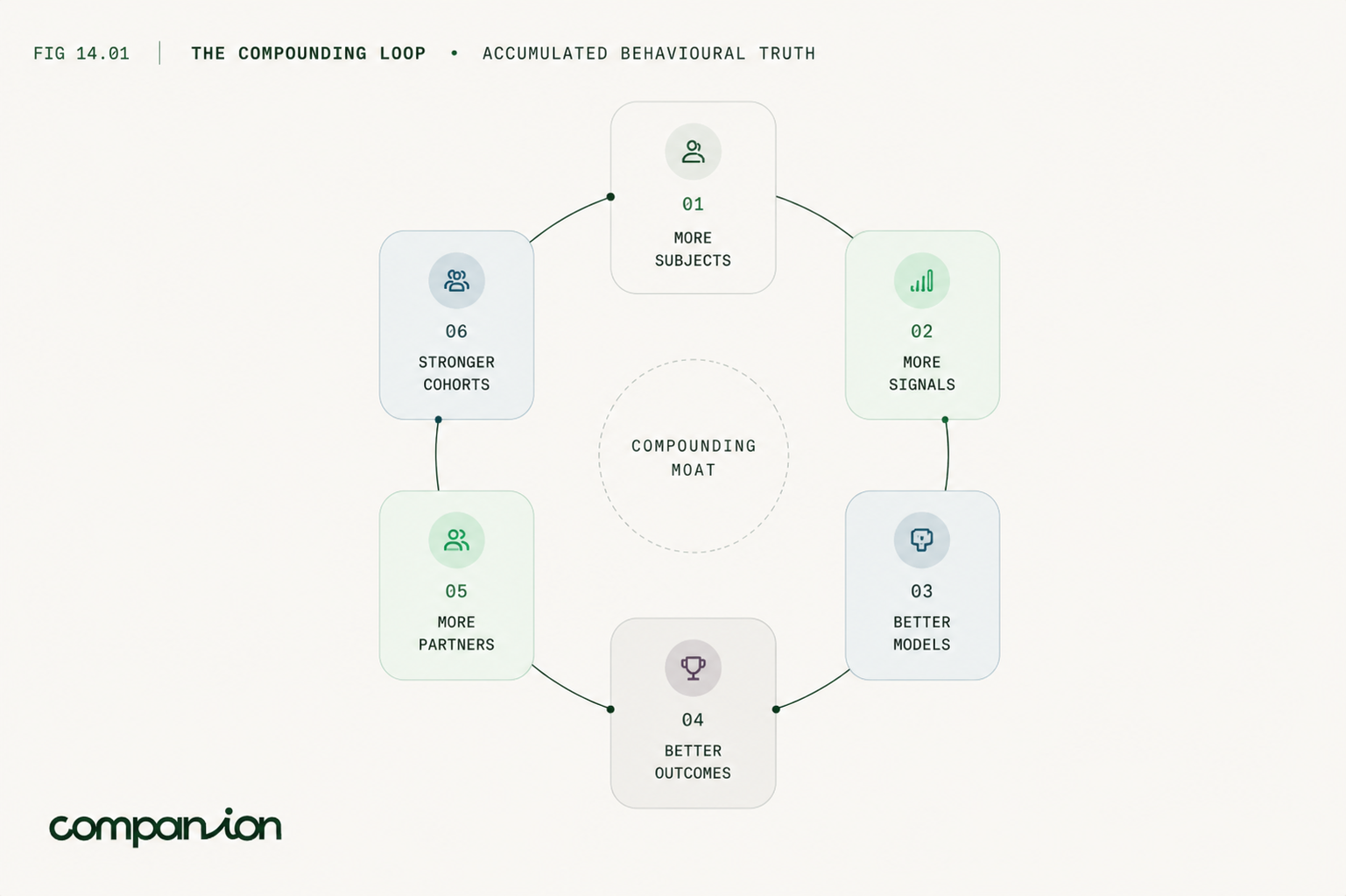
Accumulated behavioural truth is the one asset that cannot be acquired — only accrued. Each new subject, signal and partner makes the whole system smarter, and the input is time, which cannot be purchased. The canonical depiction is Fig 14.01.
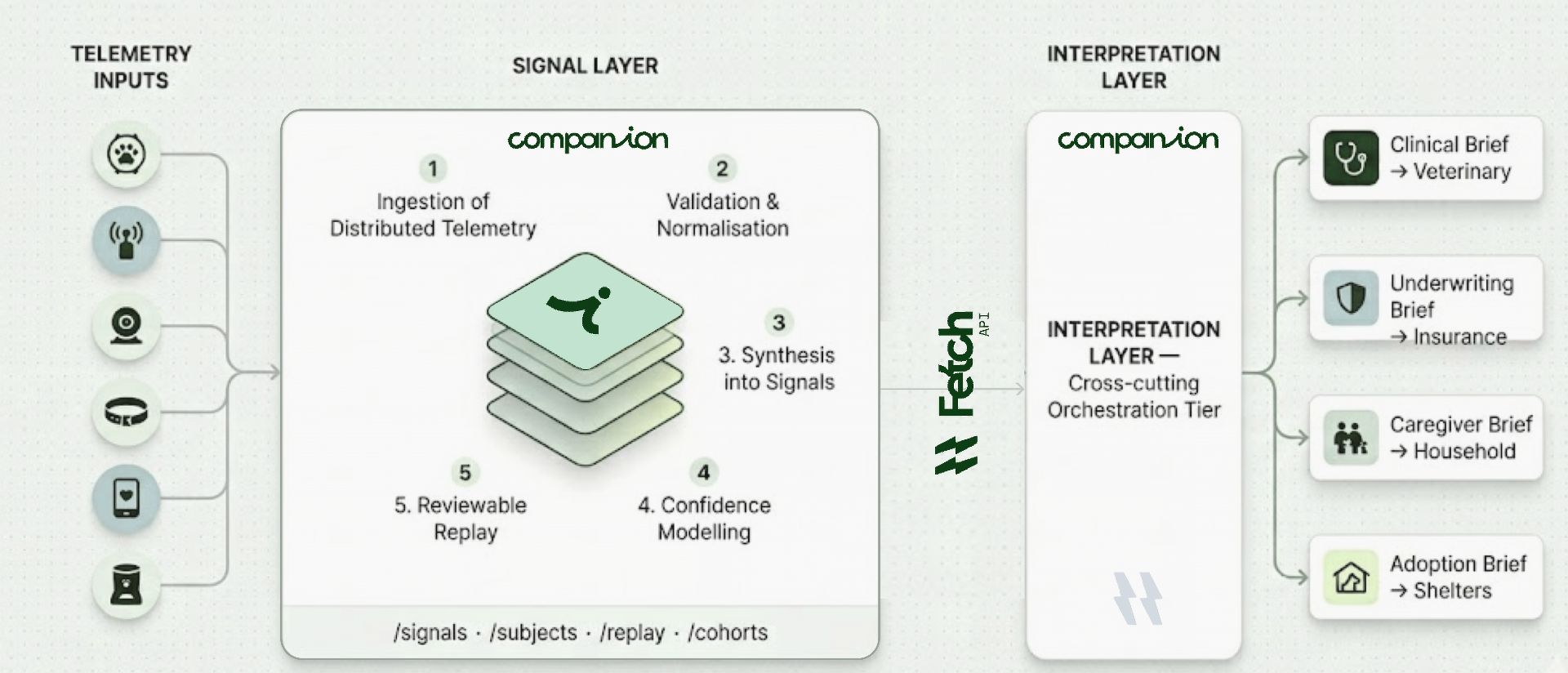
The whole model resolves to three layers. Companion interprets; Fetch delivers; consumers act. Everything in this manual serves one of the three.
The verbal and positional identity of the company — the statements that must never be paraphrased, and the voice every artifact inherits.
This statement is Level 1 Constitutional. It may be shortened for space only by removing trailing clauses, never by substituting words. "AI-powered", "real-time", "revolutionary" are forbidden in or around it (see Volume 05).
Mission — to read the signal the ecosystem already holds, and return understanding before the symptom.
Vision — a pet ecosystem where loss is prevented because risk was understood early, everywhere, through one layer.
The marks, colours and typefaces. Every value here is canonical and version-controlled — quoted, never approximated.
Companion is the platform mark; Fetch is the product mark. Each has a wordmark and a brandmark, in four colourways.





Maximum two colours plus neutral per screen. Risk colours are reserved exclusively for risk and signal states.
| Token | Hex | Role |
|---|---|---|
| --ch-green | #0E3E15 | Primary · CTAs · risk anchor |
| --ch-sage | #B1DAB9 | Secondary · on-dark accent |
| --ch-steel | #B5CFD5 | Supporting UI · accent |
| --ch-plum | #3E1033 | Editorial · narrator bars |
| --ch-green-dk | #060C07 | Dark mode ground · top bar |
The operating fabric. Not a background grid — a living, persistent coordinate system that every Companion property is drawn inside. Stripe has gradients; Apple has whitespace; Palantir has ontology. Companion has the Mesh.
A quiet, institutional fabric that communicates — without a word — that every screen, document and product is part of a single intelligence system.
It stops being “the background grid” and becomes the operating fabric of Companion — the signature that says everything here is connected.
The lattice constants are constitutional. They do not change between properties — the coordinate system is shared, so a node at x12·y08 means the same thing everywhere.
| Constant | Value | Role |
|---|---|---|
| Master lattice | 64px | Primary structure · layout spine |
| Sub-grid | 16px | Master ÷ 4 · micro-alignment |
| Baseline opacity | 2% | Whisper-quiet · never decorative |
| Coordinate origin | top-left 0·0 | Persistent across surfaces |
| Node identifier | N·{gx}{gy} | Stable reference to a lattice point |
The lattice is static; the intelligence moves. Most nodes are simply present — lonely, unconnected. A minority hold a single straight orthogonal relationship; a handful form a small local cluster. Activity behaves like weather: independent micro-events emerge and fade, nothing synchronises, nothing repeats. A travelling pulse runs straight between two nearby nodes and then disappears. Idle nodes breathe almost imperceptibly in luminance. The fabric should be invisible until noticed — present, never performing.
Beneath the lattice sit five canonical colour fields — organic multi-radial gradients, brand-locked, never free-form. They give the fabric atmosphere and depth without breaking the two-colour discipline of Volume 02.
A persistent operating fabric — calm, institutional, permanent. Continuously present, never performing.
Where the audited components live. Tokens, grid, elevation and motion — the functional vocabulary of every Companion surface.
Each is a Level 2 System element — changeable through review, not free evolution. Recreated here from the canonical tokens.
| Token | Value | Usage |
|---|---|---|
| --space-1 | 8px | Micro · inline gaps |
| --space-2 | 16px | Tight · compact rows |
| --space-3 | 24px | Default · card padding |
| --space-5 | 40px | Section spacing |
| --space-8 | 64px | Major separation |
| --space-12 | 96px | Hero spacing |
| --radius-sm | 2px | Badges · API panels |
| --radius-md | 4px | Cards · buttons · inputs |
The grid is 8pt. Radii stay near-square (2–4px) — clinical precision, never pill shapes. Borders are structural; prefer spacing over borders where possible.
| Property | Value |
|---|---|
| Columns | 12 · responsive |
| Max content width | 1280px |
| Desktop margin | 80px |
| Gutter | 24px |
| System working column | 560px |
| Elevation | contrast + spacing — no box-shadow on cards |
If it cannot, it is forbidden. Motion is triggered by data change only — never decoration. No slide-in, no bounce, no looping effects beyond the ambient system-live dot.
| Event | Duration | Notes |
|---|---|---|
| Risk interpolation | 300–600ms | Smooth value transition, no overshoot |
| Risk pulse | 400ms | Single scale pulse on threshold cross |
| Signal fade | 200ms | Opacity only, no movement |
| Status dot | 2.4s loop | Ambient system-live indicator only |
| Easing | cubic-bezier(.22,1,.36,1) | Ease-out sharp |
Companion's constitutional motion language. Apple has Human Interface Guidelines; Material has Motion; Carbon has its choreography; Palantir has ontology interactions. Companion has the MBS — not flashy, but institutional, measured, scientific.
Motion exists to reveal intelligence \u2014 never to decorate interfaces. If an animation does not improve understanding, it does not exist.
Everything in this volume derives from that one sentence. The MBS does not standardise animation for its own sake; it standardises behaviour \u2014 so a card, a signal, or a confidence score behaves identically across Runtime, Trust, FDD and CIN. Consistency of behaviour is what makes the platform feel like one institution rather than many screens.
Every animation in Companion belongs to one of these families. Each keys off a single motion token. Press replay on any specimen \u2014 it occurs once, then stops.
Almost every AI-generated interface animates everything at once. Companion paces motion like cinema: one event, pause, the next, pause \u2014 understanding accumulates. Motion follows causality (Law 04).
More important than motion. Cards lift 2px on hover (never scale) and thicken their border on select while neighbours stay still; buttons deepen and compress 120ms on press; panels appear through opacity \u2014 never slide, bounce, or overshoot. Hover a card, then select one:
Every object transitions through one shared state machine \u2014 no per-screen states:
Every object in Companion moves through one canonical lifecycle. Motion is the visible transition between two of these states — which is far more institutional than animating on click. An object's appearance always reflects exactly which state it occupies.
The Mesh (Vol 02.5) inherits the motion laws. Its behaviour is bounded so it never becomes a performing network.
| Rule | Bound |
|---|---|
| Maximum active nodes | 6 · never the whole mesh |
| Activation | local only · radius 80\u2013160px |
| Timing | random · every 8\u201315s |
| Connections | straight · appear only on information change |
| Hover / select | mesh activates beneath cursor / object |
| Forbidden | constant pulses · bezier spaghetti · fake neural net |
CIN introduces a narrative motion family distinct from component motion. A sequence is staged in acts \u2014 each holds before the next begins. Same causal order as the rhythm, at a slower documentary cadence (--motion-documentary · 1800ms).
Architecture diagrams follow identical choreography: nothing moves initially; observation enters; pause; arrow draws; pause; component activates; pause; output appears; hold. No loops, no spinning, no floating icons.
Like colour, motion is tokenised \u2014 so Runtime, CIN, Trust and FDD literally behave the same. Each bar below runs at its real token duration:
The grammar of every figure Companion draws. Signals move through fields, not boxes. The diagram language is Level 1 Constitutional — its vocabulary does not drift.
Companion figures feel engineered, not illustrated — clinical, institutional, software-native, investor-grade. They are drawn with curved trajectories, branching intelligence flows, cohort fields and replay contours. A reader should want to screenshot them. The goal is not explanation; it is memorability.
Companion diagrams are becoming a recognisable, proprietary system. These are the characteristics that make a figure unmistakably Companion — document them, so no one unknowingly draws a PowerPoint flowchart six months from now.
Five forms carry the system: layer stacks (vertical numbered structure), topologies (orbital ecosystems), flywheels (accelerating spirals), replay systems (forensic traces) and cohort fields (population context). Every approved figure is one of these. New forms require a Level 1 amendment.
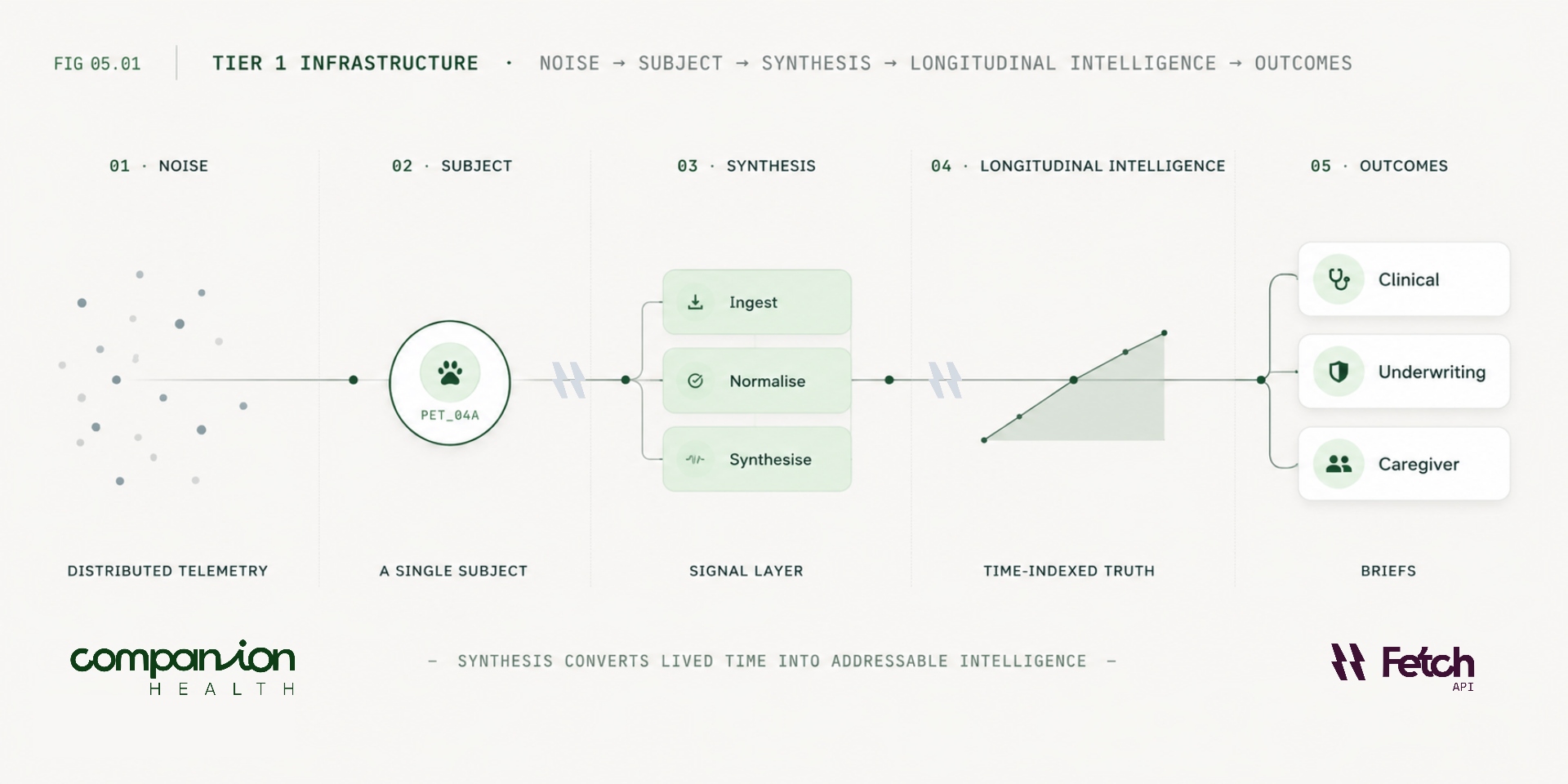
Not rules — actual approved figures. Companion treats figures as products: versioned, status-tracked, with a manifest of where each is used. This library is the canon. It will grow past fifty.
Every canonical figure carries an ID, a status, a version, and a usage manifest. A figure is never redrawn ad hoc; it is amended, re-versioned, and re-issued from here.
The words Companion uses, and the words it never uses. Vocabulary is Level 1 Constitutional — the ontology depends on it.
Approved terms are load-bearing — they name real objects in the system. Forbidden terms are not stylistic preferences; they are category errors.
Not a banned-words list — the words Companion prefers. This is the company's internal dictionary: when a generic term is reached for, the canonical one is used instead. It keeps every surface speaking one language.
| Instead of | Companion says |
|---|---|
| Dashboard | Runtime |
| Prediction | Interpretation |
| AI Platform | Continuity Infrastructure |
| Customers | Participants |
| Database | Canonical Store |
| Users | Operators |
| Alert | Signal |
Surfaces differ in register but share the voice. Website: compressed, system-first, gated. Deck: one accent word per headline, evidence below. Social: a single observation, never a thread of hype. API copy: structured labels only, no prose.
| Forbidden | Canonical |
|---|---|
| "Your pet needs urgent care!" | Signals indicate elevated risk |
| "Our AI detects diseases early!" | Risk score: 72 — Elevated |
| "Powerful insights for insurers" | Risk classification · premium impact |
| "Get started today" | Access Platform |
The condensed constitution of Companion's core document and interpretation engine — the canonical long-form artifact that states the thesis in full.
The Signal Layer is the long-form constitution: it defines the ontology, the engine, the architecture, the consumers, and the moat — in that order, without deviation.
| Pass | Scope | State |
|---|---|---|
| Pass 1 | Ontology & thesis — what a signal is | Ratified |
| Pass 2 | Engine, architecture, consumer model | Ratified |
| Pass 2.5 | Experience elevation — atmosphere & depth | Ratified |
| Pass 2.6 | Diagram language → branded V3 figures | Current |
The Signal Layer is now a first-class BOS artifact, governed alongside this manual.
Records say what happened. The Signal Layer says what is changing — and reads it before the symptom does.
The contract through which all intelligence is delivered. What Fetch is, what it is not, and the standards every endpoint and annotation obeys.
Endpoints map one-to-one to ontology objects. A consumer does not learn a product; they query the model directly. The contract is stable — endpoints are added, never repurposed.
API surfaces render in the dark instrument palette: near-black ground, sage-tinted mono, structural borders. Verbs in sage, strings in light sage, comments dimmed. Numeric values always Suisse Mono. No prose inside payload examples — labels only.
How the constitution stays stable while it grows. Freeze events, audits, severity, and the amendment process that governs this document and every artifact under it.
Severity maps to the BOS Constitutional Status (Preamble). It determines the gate a change must clear before it ships.
| Severity | Touches | Gate |
|---|---|---|
| Minor | Level 3 operational — decks, social, campaigns | May evolve freely |
| Major | Level 2 system — components, tokens, figures | Requires review |
| Constitutional | Level 1 — identity, vocabulary, ontology, diagram grammar, governance | Requires amendment process |
No Level 1 change is valid until it appears in the amendment ledger (Appendix). Constitutional amendments require an explicit freeze of the affected volume during review, and a version increment on ratification. Level 2 changes require review and a changelog entry; Level 3 changes ship freely but inherit all higher-level constraints.
Every future decision — a feature, a surface, a partnership, a deck — must answer five questions. If the answer is no, it is not built.
A freeze event locks a volume for the duration of an audit or major revision; nothing downstream may cite the frozen volume's draft state. Freezes are recorded in the ledger alongside the amendment they protect.
The public expression of the thesis. Content pillars, the asset engine, and the cadence — all Level 3 operational, all inheriting the constitution above.
Every output begins as research and descends the chain. Nothing is produced sideways — a carousel without a research nucleus is not approved. The diagram step always pulls from the Figure Library; the deck step always uses the Companion × Fetch framework (Vol 03).
| Surface | Cadence | Structure |
|---|---|---|
| Signal Essay | Monthly | One claim · evidence · figure |
| Research Note | Bi-weekly | Finding · method · implication |
| Diagram post | Weekly | Figure · one-line read |
Not just social — the content engine. Every format Companion produces derives from a single framework, so the thesis stays identical from a LinkedIn post to an investor memo.
LinkedIn, whitepapers, research notes, signal essays, partner content, conference talks and investor material all derive from one research nucleus. The format changes; the argument does not.
If two artifacts about the same finding make different arguments, one of them is wrong. The nucleus is the arbiter.
The master inventory. Every approved artifact, its governance level, and its state — version-controlled, never duplicated.
Where everything lives. A defined structure so artifacts are found, not rediscovered — institutional memory has an address.
A file without a home is a decision waiting to be rediscovered. Everything has an address; the address is the memory.
A constitution is only stable if its changes are recorded. Every ratified amendment is logged here with its severity and scope.
| Version | Date | Severity | Change |
|---|---|---|---|
| v4.0 | 2026 · 06 | Constitutional | Coherence revision — the BOS now reads as one operating system. Added the constitutional system map and the reveal principle (Preamble), the product architecture tree and the Companion Signature (five marks of recognition), Companion Vocabulary (preferred ontology, § 5.2b), Companion States (eight-state lifecycle, § 3.5.5b), diagram proprietary characteristics (§ 4.1), figure metadata (Vol 04.5), and the Decision Framework (§ 8.3). |
| v3.0 | 2026 · 06 | Constitutional | Added Volume 03.5 — Motion & Behaviour System (MBS): the constitutional motion language — one philosophy (motion reveals intelligence), six motion laws, the seven-family taxonomy (A Arrival – G Transition), motion rhythm, the shared behaviour state machine, Mesh behaviour bounds, documentary motion, the per-screen animation budget, and --motion-* tokens. Demonstrated live via mbs.css + mbs.js. |
| v2.0 | 2026 · 06 | Constitutional | Added Volume 02.5 — The Intelligence Mesh: the operating-fabric system (64px master / 16px sub lattice, 2% baseline, persistent coordinates, signal propagation) and the brand-locked mesh-gradient system. Shipped as the companion-mesh component + mesh.css. Mesh v1.1 refinement: network → ambient intelligence field — ~80% lonely nodes, straight orthogonal relations, independent weather-model signals, luminance-only breathing, density reduced ~60%. |
| v1.0 | 2026 · 06 | Constitutional | Ratification of CH-BOS. Consolidation of Identity, Brand, Design, Diagram, Language, Signal Layer, Fetch, Governance, Social and Repository standards into a single governed source of truth. |
| — | open | Major | Next: expand Figure Library toward the 50-figure canon; admit Dashboard component specimens as they clear audit. |
Set in Faire Octave (display), Suisse Intl (text & UI) and Suisse Intl Mono (labels, code, clause numbers). Colour, type, spacing and component tokens are imported live from colors_and_type.css — this manual renders from the same source of truth it governs.
Maintained by Companion Health / Animetric. Amendments are proposed, reviewed and ratified under the process defined in Volume 08. This is institutional memory. Keep it current; keep it stable.